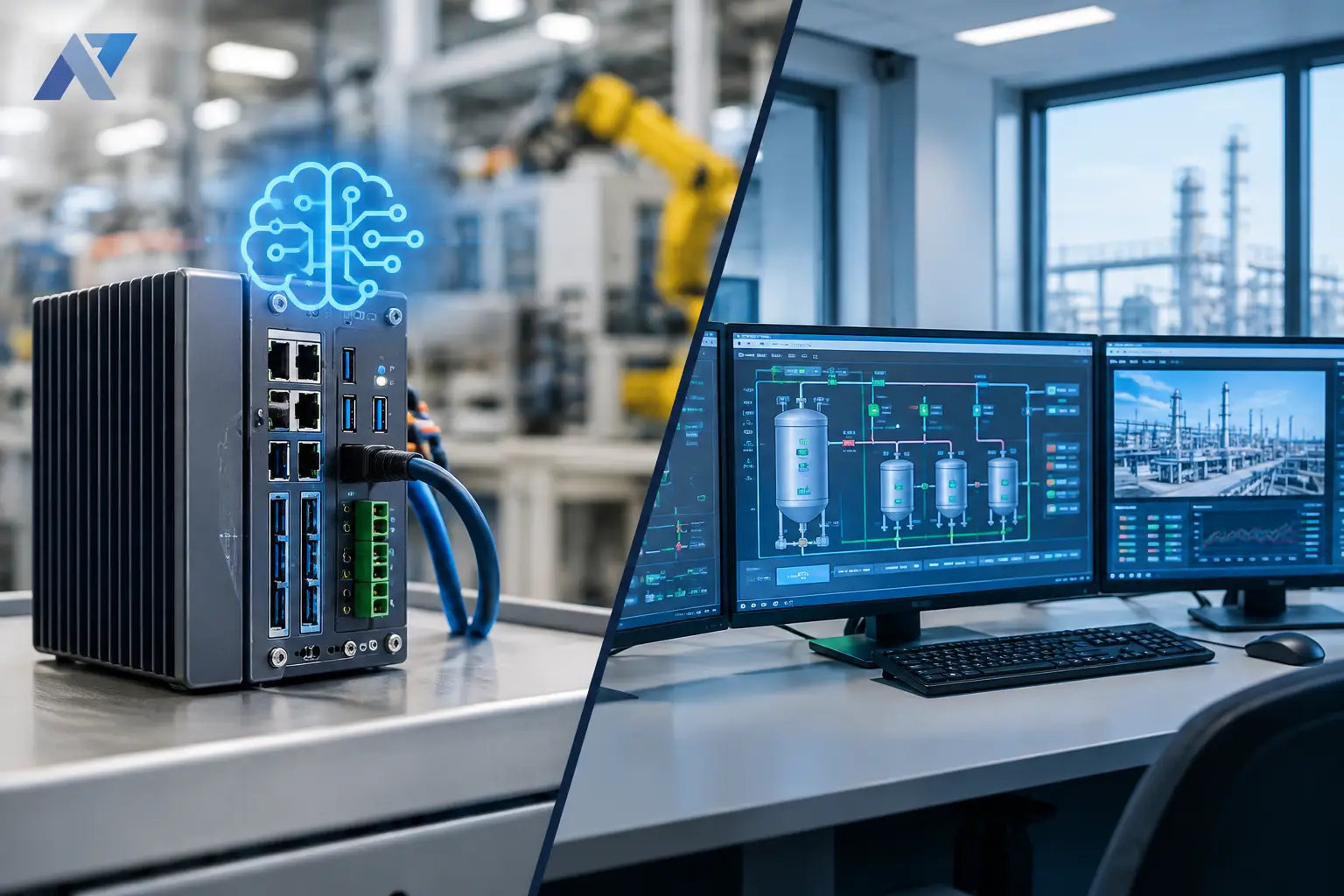
At 3pm, when production load, cooling demand and site consumption rise together, visibility alone does not reduce a maximum-demand charge. This is the practical difference in the debate around AI controllers versus SCADA systems: one can show an operator what is happening, while the other can help decide and act on what should happen next.
For industrial and commercial energy users, this is not a software preference. It affects electricity cost, solar self-consumption, battery value, equipment uptime and the quality of reporting presented to finance, operations and sustainability teams.
AI Controllers Versus SCADA Systems: Different Jobs
SCADA, or Supervisory Control and Data Acquisition, is established technology for monitoring and supervising physical assets. It collects signals from meters, sensors, relays, inverters, PLCs and other field equipment, then presents them through dashboards, alarms, trends and control screens. In an energy environment, a SCADA system may show live demand, solar generation, battery state of charge, breaker status and equipment faults.
That operational visibility is valuable. Engineering teams need a reliable record of what assets are doing, particularly across complex sites with multiple substations, production lines or distributed renewable systems. SCADA can also support supervisory commands, such as switching equipment or setting operating parameters, subject to the configured control logic and site permissions.
An AI controller has a different primary purpose. It uses live data, historical operating patterns, tariff structures, weather inputs, forecasts and site constraints to optimise decisions continuously. Rather than only reporting that demand is approaching a threshold, it can identify the likely demand trajectory and coordinate a response before the peak is recorded.
The distinction is not that SCADA is outdated or AI is automatically better. They solve different parts of the energy-management problem. SCADA provides a dependable operational window into the site. Enterprise-grade AI adds a decision layer that turns data into smarter control.
Monitoring Is Essential, But It Is Not Optimisation
Many high-energy-demand facilities already have dashboards. Yet operators may still need to compare spreadsheets, interpret half-hourly data and decide manually whether to curtail non-critical load, alter plant schedules or discharge a battery. By the time a decision is made, the demand event may have already occurred.
A conventional SCADA deployment is often configured around fixed thresholds and rule-based sequences. For example, an alarm might activate once site demand exceeds a set level. This works well for safety, asset protection and clear operating limits. It is less effective where conditions change by the minute: cloud cover reduces solar output, an air-compressor starts unexpectedly, or a production batch extends beyond schedule.
AI control is designed for this variability. It learns how a site behaves and evaluates possible actions against commercial and technical priorities. Those priorities may include reducing peak demand, prioritising solar energy, protecting battery life, maintaining reserve capacity, or avoiding disruption to production.
The result should be real savings, not theoretical optimisation. A controller must operate within engineering-approved constraints, with auditable actions and clear escalation rules. No commercial energy strategy is improved by an automated system that compromises process quality or equipment reliability to chase a marginal saving.
Where AI Control Creates Financial Value
The strongest business case usually comes from coordinating assets that were previously operated in isolation. Solar PV, BESS, HVAC systems, air-compressors, production loads and grid supply all influence a facility’s demand profile. Managing each asset separately can leave significant value on the table.
Demand control and peak shaving
For sites exposed to high demand charges, a short consumption spike can have an outsized financial impact. AI controllers forecast demand from live metering and operational patterns, then determine whether action is required. Depending on the site design, this may involve dispatching battery power, adjusting flexible loads or delaying non-essential consumption.
A fixed rule may discharge a battery whenever demand crosses a threshold. An intelligent approach can preserve battery capacity where a larger peak is forecast later in the billing period or production cycle. This is particularly important for facilities where the battery must serve more than one objective.
Solar prioritisation and battery dispatch
Solar generation is variable, but its value can be increased through better timing. An AI controller can prioritise on-site solar consumption, assess whether to charge a BESS from surplus generation and avoid unnecessary grid import where operationally viable.
Battery dispatch requires further discipline. Using stored energy at the wrong time can leave the site exposed during a later peak. Cycling too aggressively can also affect long-term asset performance. A controller should therefore balance immediate cost reduction with state-of-charge limits, warranty conditions, reserve requirements and expected solar availability.
Load shedding without operational guesswork
Load shedding is often associated with emergency action. In a well-designed energy strategy, it can be a planned and selective response. AI control can identify approved flexible loads, rank them by operational impact and act only when a defined demand or grid event requires intervention.
This does not remove the need for site rules. It makes those rules more responsive. Critical process loads, safety systems and protected equipment remain outside automated curtailment decisions, while suitable discretionary loads can be managed with greater precision.
When SCADA Remains the Right Foundation
SCADA is still the appropriate starting point where a business lacks basic metering visibility, asset communications or a reliable control architecture. A controller cannot make high-quality decisions from incomplete, inaccurate or delayed data. Metering integrity, communications resilience and clearly defined equipment interfaces come first.
SCADA is also well suited to applications where the objective is direct supervision rather than economic optimisation. Safety interlocks, plant status, alarm management and standard operating sequences need deterministic, transparent behaviour. These functions should not be replaced casually by a predictive model.
For many organisations, the best architecture is not AI instead of SCADA. It is SCADA and AI, each assigned to the role it performs best. SCADA provides field-level visibility, alarms and supervisory control. The AI layer analyses energy behaviour, forecasts outcomes and issues optimisation commands within approved boundaries.
Questions to Ask Before Choosing an Architecture
Decision-makers should begin with the commercial problem, rather than the technology label. If the priority is improved fault visibility across solar assets, monitoring and SCADA capability may be the immediate need. If the priority is lowering maximum demand, coordinating BESS dispatch and increasing solar self-consumption, AI optimisation becomes more relevant.
The quality of the integration matters as much as the software. Ask whether the platform can ingest interval meter data and real-time signals, whether it connects to existing inverters and battery systems, and how it handles sensor data from HVAC and air-compressors. Confirm who retains control authority, how manual override works and how actions are recorded for engineering review.
Reporting should also be part of the requirement. Finance teams need a clear view of avoided cost and demand performance. Operations teams need evidence that control actions supported uptime. Sustainability teams need trustworthy consumption and emissions data for Scope 1 and Scope 2 reporting. A useful system presents the same operational truth in forms that each stakeholder can use.
Amsolar AI applies this integrated model by connecting physical energy assets with intelligent optimisation software, supported by practical solar engineering and commissioning experience. That combination matters because control strategies only create value when they reflect the realities of a live industrial site.
Build for Control, Not Just Visibility
The next-generation energy site will not be managed through dashboards alone. It will combine accurate monitoring, disciplined engineering controls and AI-led decisions that respond at operational speed. The objective is not to automate every switch. It is to automate the right decisions, at the right time, with measurable financial and operational benefit.
For organisations assessing their next investment, start with a demand profile, asset inventory and a clear definition of which loads are flexible. That evidence will show whether the immediate opportunity is better visibility, smarter control, or an integrated path to both.