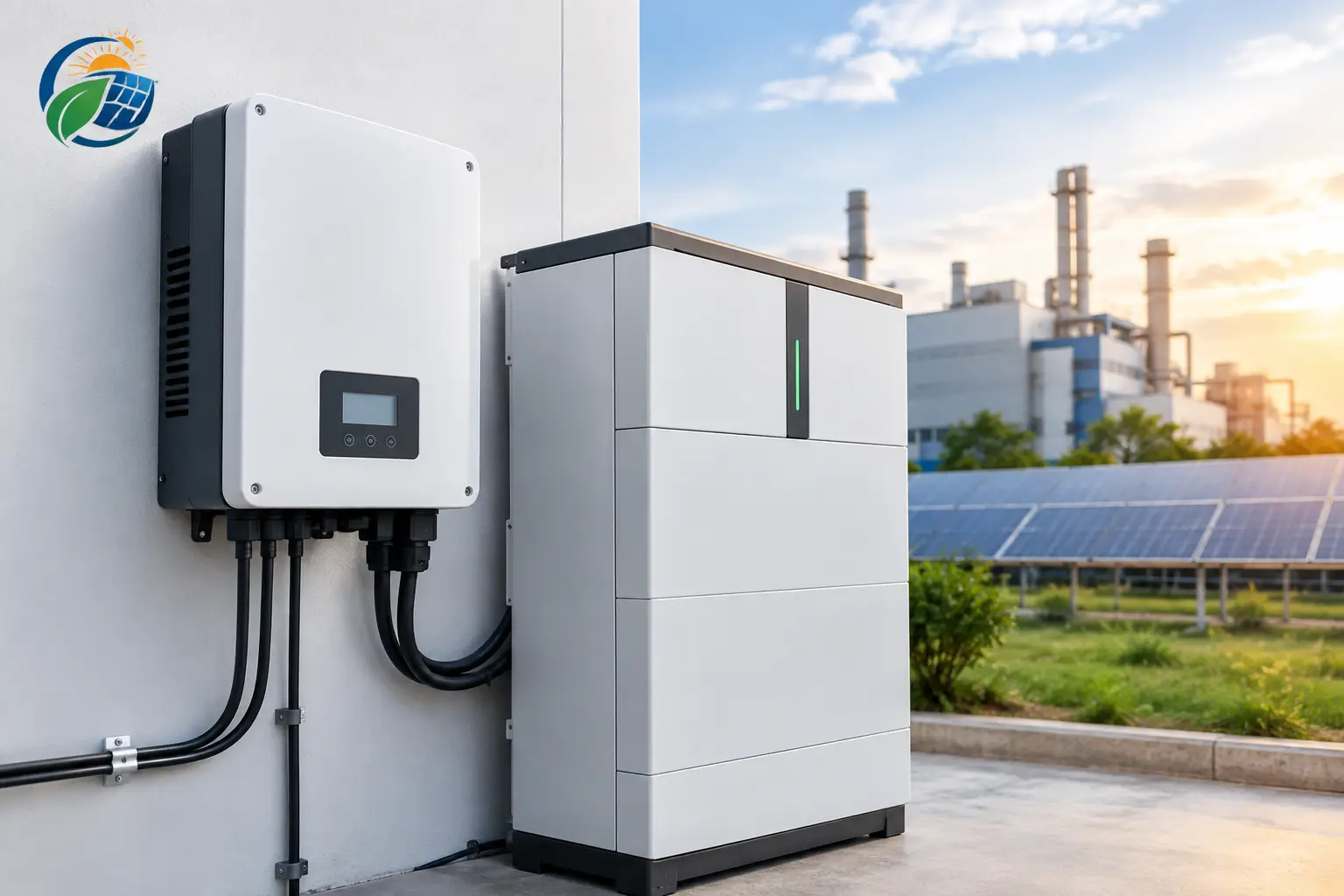
A factory can have ample rooftop solar, a correctly sized battery and a modern inverter, yet still pay avoidable maximum-demand charges. The issue is rarely the hardware alone. In the solar inverter versus battery control discussion, the commercial question is whether each asset is simply operating or actively being coordinated around site demand, tariff exposure and production priorities.
For industrial and commercial users, this distinction affects cash flow, uptime and the credibility of energy-performance reporting. An inverter converts solar generation into usable electricity. Battery control decides when stored energy should be charged, held or discharged. Both are necessary, but neither delivers its full value in isolation.
Solar inverter versus battery control: different jobs
A solar inverter is the conversion and protection layer of a photovoltaic system. It takes the direct current produced by solar modules and converts it to alternating current for site loads or grid export. It also manages grid synchronisation, anti-islanding protection, voltage limits and generation data.
Its primary purpose is to make solar energy available safely and efficiently. When irradiance is high and the site has active load, the inverter enables solar self-consumption. When solar output exceeds immediate demand, the system may export power, curtail generation or direct available energy towards a battery, depending on the site design and control settings.
Battery control has a different mandate. A battery energy storage system, or BESS, stores electricity, but the battery itself does not determine the best commercial use of that energy. The battery management system protects cells and monitors state of charge, temperature and health. Higher-level battery control determines dispatch: whether to charge from excess solar, reserve capacity for a forecast peak, discharge to reduce maximum demand or retain energy for resilience.
This is why an inverter should not be viewed as a substitute for intelligent battery control. Inverter settings can establish basic operating rules. They cannot reliably account for changing production schedules, load volatility, tariff windows, weather forecasts and demand thresholds across an energy-intensive site.
Why basic control can leave savings on the table
A common configuration charges the battery whenever excess solar is available and discharges it once solar output falls. This approach may improve solar self-consumption, but it can be commercially weak. A battery that discharges too early may be unavailable when a process start-up, chiller cycle or compressed-air load pushes the site above its monthly demand threshold.
Similarly, a solar-first rule is not always the best rule. If a site expects a sharp afternoon demand peak, conserving battery capacity may be worth more than using every available kilowatt-hour immediately. The correct decision depends on the tariff structure, contracted capacity, production plan, state of charge, battery degradation considerations and the financial value of avoiding a demand spike.
Industrial facilities also face a practical operational constraint: generation and load change at different speeds. Solar output can fall quickly under cloud cover. Load may rise suddenly when machinery, HVAC equipment or compressors start together. Without coordinated monitoring and automated response, the grid supplies the shortfall and the site may set a new maximum-demand peak in minutes.
Inverter data is valuable, but it is not a control strategy
Inverter portals show generation, faults and performance indicators. This visibility is valuable for asset maintenance and solar verification. However, a generation dashboard does not necessarily show why the facility imported expensive power at a particular moment, whether battery capacity was preserved for the right event, or which loads drove the peak.
Energy teams need a single operational view across solar, BESS, grid meters and key consumption assets. For sites with significant HVAC and compressed-air demand, environmental and equipment signals can add meaningful context. The objective is not more data for its own sake. It is a clear, auditable explanation of energy use and an automated path to better decisions.
What coordinated control looks like in practice
Effective energy control begins with measurement at the right points: grid import and export, solar output, battery power and state of charge, plus relevant load data. The controller then applies site-specific logic that reflects commercial and operational limits.
For example, during a strong solar period, the controller may prioritise direct supply to production loads, then charge the BESS using surplus generation. If forecasting identifies a high-risk late-afternoon peak, it can maintain a defined battery reserve rather than allowing unrestricted discharge earlier in the day. When demand approaches a configured threshold, the system can dispatch battery power fast enough to flatten the peak.
The strategy must also respect battery health. Frequent deep cycling, unnecessary grid charging and high-power dispatch may shorten battery life or reduce the economic case. Smarter control balances near-term savings with asset longevity. Real savings, not theoretical savings, depend on this balance being engineered for the site rather than copied from a generic template.
For some facilities, controlled load shedding is also part of the plan. Non-critical loads can be curtailed according to agreed priorities if demand exceeds a safe limit or a grid event threatens operations. This requires careful engineering and governance. A control system should protect essential processes, not introduce avoidable production risk.
Choosing the right architecture
The suitable design depends on the starting point. A solar-only site may benefit first from improved inverter monitoring, generation analysis and a clear self-consumption strategy. A site with high and volatile maximum demand may see stronger returns from integrating BESS dispatch with interval-meter data and demand forecasting.
Where solar and BESS are both present, the greatest value usually comes from a supervisory energy-management layer above the individual asset controllers. This layer should receive real-time data, forecast site conditions, optimise dispatch and record the outcome for operations and finance teams. It should not override inverter or battery safety protections; it should work within them.
There are also cases where battery control should prioritise resilience over immediate bill reduction. A facility with sensitive processes, weak grid quality or costly downtime may reserve energy for contingency support. The financial model should recognise avoided disruption, not only electricity arbitrage or peak shaving.
Questions decision-makers should ask
Before approving a control upgrade, teams should establish whether the system can distinguish solar generation from site demand, forecast demand peaks and explain every battery dispatch decision. They should also ask how control priorities are configured, who can change them, what happens during communications loss and how performance is reported against a defined baseline.
Reporting matters because energy savings require verification. Finance teams need traceable evidence of reduced import, lowered maximum demand and avoided tariff exposure. Engineering teams need fault visibility and asset-health indicators. Sustainability teams need reliable information for Scope 1 and Scope 2 reporting and energy-efficiency obligations. One disconnected portal per asset rarely satisfies all three groups.
Amsolar AI applies enterprise-grade AI, real-time analytics and engineering-led control to connect these requirements in one operating environment. The aim is practical: prioritise solar, manage battery dispatch intelligently, reduce avoidable demand exposure and give stakeholders a transparent record of performance.
The commercial decision is not inverter or battery
The solar inverter versus battery control question can sound like a choice between technologies. For most high-energy-demand organisations, it is better understood as a hierarchy. The inverter enables solar production. The battery provides flexible energy capacity. Intelligent control coordinates both around the site’s actual economic and operational objectives.
The right next step is to examine a representative month of interval data alongside solar production, existing battery behaviour and maximum-demand events. That analysis will show whether the constraint is asset capacity, poor visibility, static settings or a lack of coordinated control. From there, an energy strategy can be built around the moments that genuinely drive cost and operational risk – not just the equipment installed on site.