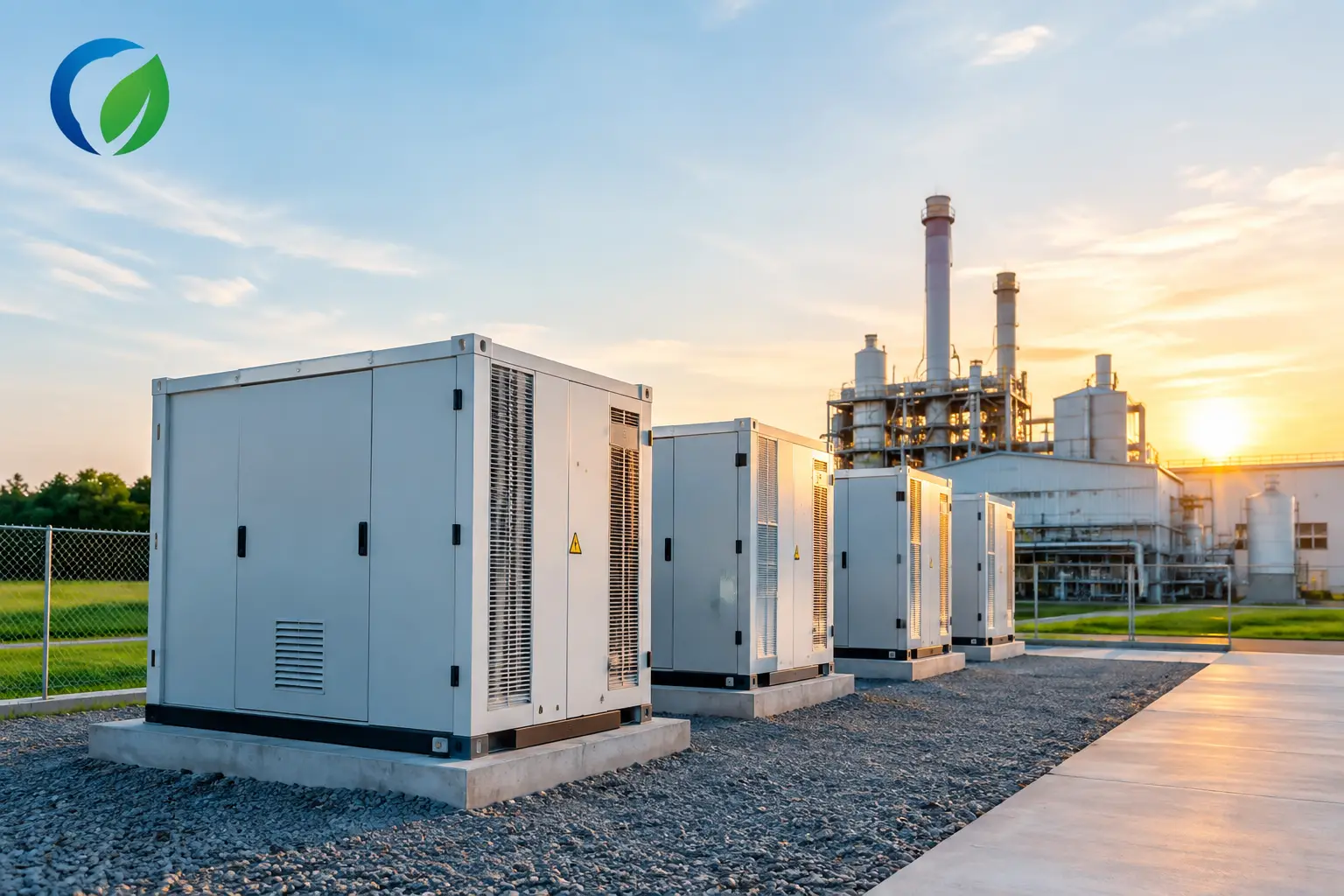
A production line is ready to start, compressors are cycling, HVAC demand rises and solar output begins to fall. At that moment, a site may approach its maximum-demand threshold or exceed the available capacity of its incoming supply. Power boosting by BESS gives industrial and commercial facilities a controllable reserve of electricity at the point of use, helping them support critical loads without relying solely on costly grid capacity upgrades.
For high-energy-demand organisations, this is not simply a battery application. It is an operational strategy that combines battery energy storage, real-time site data and intelligent dispatch to manage demand when it matters most. The commercial value comes from avoiding avoidable peak charges, protecting uptime and making better use of on-site solar generation.
What power boosting by BESS means
A battery energy storage system, or BESS, stores electricity for later use. In a power-boosting configuration, the battery discharges alongside the grid supply when site demand temporarily rises above a preferred limit or approaches the capacity available from the grid connection.
The grid continues to serve the facility, while the BESS supplies the additional power required for a defined period. This can prevent a short-duration demand spike from setting a higher billing demand, triggering load constraints or forcing an organisation to invest early in a larger supply connection.
Consider a factory with a 2 MW grid connection and a process load that occasionally reaches 2.3 MW during simultaneous equipment start-up. Rather than accepting a capacity shortfall or curtailing production, a 500 kW BESS can contribute the additional power during that event. The battery is then recharged at a more suitable time, based on tariff periods, solar availability and the next anticipated demand window.
The principle is straightforward. The engineering and financial case, however, depends on how consistently the site can identify, predict and control those demand events.
Why industrial sites need smarter power support
Electricity demand is rarely flat across an operating day. A cold-store facility may see peaks when refrigeration systems recover after door openings. A manufacturing plant may experience sharp ramps as motors, furnaces, air compressors and process equipment operate together. Commercial campuses can see a similar pattern when cooling systems, lifts and charging loads coincide.
These peaks may last only minutes, but their consequences can extend across a billing cycle. Where tariffs include maximum-demand charges, one unmanaged event can materially increase electricity costs. In other cases, limited incoming capacity becomes a practical barrier to production expansion, electrification or new equipment installation.
Conventional responses have limitations. Increasing transformer or grid connection capacity can require significant capital expenditure, approvals and long lead times. Manual load shedding can protect the supply but may interrupt operations. Diesel generation provides backup power, yet brings fuel costs, emissions, maintenance requirements and a weaker fit with corporate sustainability targets.
Power boosting by BESS provides another option: targeted electrical support that responds at high speed, operates without on-site combustion and can serve several value streams across the year.
The difference between peak shaving and power boosting
Peak shaving and power boosting are closely related, but they are not identical operating objectives.
Peak shaving is focused on reducing the highest measured demand. The BESS discharges when site load exceeds a pre-set threshold, keeping import from the grid below a chosen maximum-demand level. Its primary goal is demand-charge reduction.
Power boosting is focused on capability. The BESS adds power when the site requires more than its grid connection, transformer or operational limit can comfortably provide. Its primary goal may be to keep production running, support a new load or defer network reinforcement.
A well-designed system can do both. It may reserve sufficient battery capacity to support critical production loads while using the remaining available capacity for daily peak shaving. The trade-off is important: maximising one benefit can reduce availability for another. A battery fully discharged for tariff optimisation cannot also provide its planned power boost later that afternoon.
This is why fixed schedules are rarely enough for complex sites. Effective dispatch requires clear priorities, measured load behaviour and controls that can adapt as operating conditions change.
What determines whether a BESS can boost power effectively
Battery size alone does not define a power-boosting solution. Decision-makers need to assess both power and energy requirements. Power, measured in kW or MW, determines how much additional capacity the BESS can provide at a given moment. Energy, measured in kWh or MWh, determines how long it can sustain that output.
A 1 MW battery with 1 MWh of usable energy may provide a full 1 MW boost for about one hour under suitable conditions. If the site only needs the additional power for ten minutes during equipment start-up, the same system may support several controlled events, subject to recharge timing and operational constraints.
The following factors shape the right design:
- The size, frequency and duration of demand peaks
- The available grid capacity and transformer limits
- Critical versus flexible loads during constrained periods
- Solar generation profile and opportunities for battery charging
- Tariff structure, including maximum-demand and time-of-use charges
- Required backup reserve, battery degradation assumptions and future site expansion
A load profile should be analysed at sufficiently granular intervals. Fifteen-minute data can identify broad demand patterns, but high-resolution metering is often needed to reveal short power ramps and equipment start-up behaviour. The battery must also be integrated with protection systems, switchgear and site operating procedures. Power boosting is an electrical-engineering application first, supported by software intelligence.
Why AI control changes the business case
A battery can discharge on a timer. That approach is simple, but it does not account for changing production schedules, weather, solar output, tariff periods or unexpected demand.
Enterprise-grade AI control uses live meter data, forecasts and operating rules to make better dispatch decisions. It can anticipate a likely peak, preserve battery charge for a planned high-load period, prioritise solar charging when conditions are favourable and respond quickly when actual demand differs from forecast.
For example, if solar output is expected to decline because of cloud cover while a production batch is due to begin, the controller can avoid discharging too early. If demand stays below expectation, it can retain stored energy for a later event. If a site approaches a defined import limit, the control platform can initiate battery support before a breach occurs.
This coordinated approach also improves visibility. Energy, operations and finance teams need to see why the battery discharged, how much peak demand was avoided, whether solar energy was stored rather than exported, and what savings were achieved. Real savings, not theoretical performance, depend on reporting that connects battery activity to utility outcomes and operational events.
Amsolar AI combines integrated BESS capability with real-time analytics, forecasting and intelligent control, helping industrial and commercial users move from passive monitoring to smarter energy decisions. Where solar, HVAC, compressors and process loads influence site demand, a unified management environment provides a clearer basis for action.
Where power boosting delivers the strongest value
The strongest cases are generally sites with recurring, predictable demand constraints rather than occasional unexplained spikes. Factories nearing their connection limit, facilities with high maximum-demand charges, and organisations planning electrification can all benefit from assessing a BESS-led alternative to immediate grid upgrades.
Solar-equipped sites may see additional value because surplus daytime generation can charge the battery for use later. This improves solar self-consumption while reducing evening grid import. Yet solar should not be assumed to solve every power-boosting need. A site operating predominantly overnight, or one with highly variable peak events, may require a different charging strategy and a larger grid-charged reserve.
Battery economics also depend on operational discipline. If production schedules change without being reflected in the control strategy, expected savings may not materialise. If backup power is the first priority, the usable capacity for demand management must be adjusted accordingly. Transparent rules are essential: which loads are critical, what reserve must be retained, and when the battery may be deployed for cost optimisation.
Turning stored energy into operational headroom
A BESS should not be treated as an isolated asset installed beside a meter room. Its value increases when it is connected to the operational reality of the site: production timing, equipment status, solar output, tariff exposure and energy-performance objectives.
The practical starting point is a measured assessment of demand data, electrical constraints and future load plans. From there, the right system can be sized around the power boost required, the duration of each event and the value of avoiding demand penalties or infrastructure expansion. Controls should then be commissioned with site teams, tested against realistic scenarios and reviewed through transparent reporting.
For industrial and commercial organisations, stored energy is becoming more than standby capacity. With engineering-led design and intelligent control, it becomes operational headroom: available precisely when the site needs power most, and managed with a clear view of cost, uptime and future-ready performance.