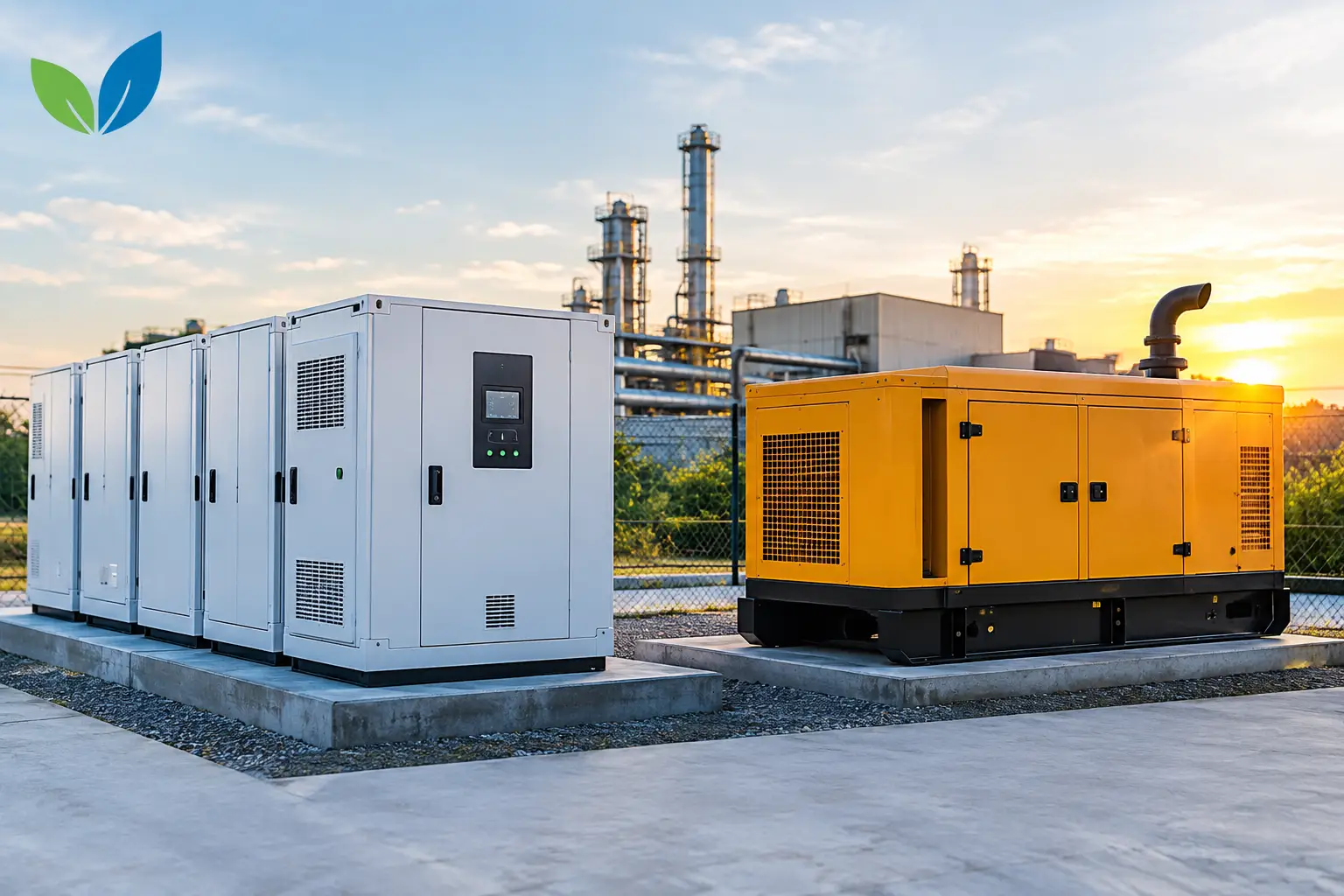
A diesel generator has long been the default answer to site resilience: it starts when the grid fails, carries critical loads and keeps production moving. But for high-consumption facilities, BESS dispatch versus diesel generators is no longer only a standby-power decision. It is a daily operating-cost, maximum-demand, solar-utilisation and emissions decision – one that requires smarter control rather than a simple equipment comparison.
BESS dispatch versus diesel generators: the key difference
A diesel generator converts stored fuel into electricity when called upon. It is proven technology, particularly for prolonged grid outages, remote sites and applications requiring high fault-current capability. Yet its economics are largely event-driven. It is normally idle, then incurs fuel, maintenance, testing and emissions costs when it runs.
A battery energy storage system, or BESS, stores electricity for controlled release. Its value comes from dispatch: deciding precisely when to charge, when to discharge, how much power to deliver and which site objective takes priority. That objective may be reducing maximum demand, capturing surplus solar generation, avoiding a tariff peak, supporting a load-shedding sequence or protecting a critical process.
The distinction matters. A generator responds after an event. An intelligently dispatched BESS can act before the costly event occurs. It can discharge as site demand approaches a contracted threshold, charge during lower-cost periods or absorb solar output that would otherwise be exported or curtailed.
For industrial and commercial users, this makes a BESS an active energy asset rather than merely an emergency asset.
Cost is about more than fuel price
Comparisons often begin with diesel fuel cost, and they should not end there. Generator operation includes fuel delivery and storage, routine servicing, engine wear, lubricant use, emissions controls, compliance requirements and periodic load-bank testing. The cost profile can also be volatile when fuel prices rise or supply is disrupted.
A BESS has an upfront capital requirement and its cells will degrade over time. It also has charging losses and must be correctly sized for both power, measured in kW or MW, and energy duration, measured in kWh or MWh. A battery designed only for a short peak-shaving event cannot sustain a multi-hour outage simply because its inverter has a high power rating.
However, a BESS can create value across many operating days, not only during an outage. Where maximum-demand charges are material, avoiding a few short demand spikes may produce real savings, not theoretical savings. When paired with on-site solar, the battery can shift midday generation into later operating periods, increasing solar self-consumption and reducing grid imports.
The strongest business case assesses the whole site load profile: 15- or 30-minute demand intervals, operating shifts, tariff windows, solar output, generator run hours, critical-load requirements and expected production changes. A nameplate comparison between a battery and a generator does not reveal that value.
Uptime requires a layered design
Diesel remains valuable where outages are long, fuel logistics are dependable and the site needs sustained backup power. A generator can continue operating as long as fuel is available and maintenance standards are maintained. For life-safety systems and certain process loads, it may remain an essential part of the resilience architecture.
A BESS offers different strengths. It can respond in milliseconds, bridging the gap before a generator starts and stabilises. That fast response can protect sensitive equipment from voltage disturbance and prevent a brief interruption from becoming a production loss. It can also reduce generator cycling by covering short events or carrying a controlled portion of the load.
In many facilities, the better question is not whether to choose battery or generator. It is how to coordinate both. A hybrid configuration can use the BESS for daily demand control, solar optimisation and instant ride-through, while retaining the generator for extended contingency operation. This can lower fuel consumption and operating hours without compromising resilience.
The design must be engineered around the actual critical-load hierarchy. Not every load deserves battery-backed supply. Separating essential process equipment, safety systems, IT infrastructure and non-critical consumption allows the available energy to be used where it protects the most operational value.
Dispatch intelligence determines battery value
A BESS without a clear dispatch strategy can underperform. Charging at the wrong time may increase site demand. Discharging too early may leave insufficient capacity for a later peak or outage. Holding too much reserve may protect resilience but reduce the financial return from daily optimisation.
Enterprise-grade AI addresses this balancing act with real-time monitoring, load forecasting and automated control. The platform should understand the site’s present demand, forecast likely peaks, track solar availability, maintain a defined state-of-charge reserve and command the battery within safe operating limits.
A practical dispatch hierarchy may prioritise critical backup reserve first, then maximum-demand control, then solar charging and tariff optimisation. The order changes by site. A factory with expensive demand charges may prioritise peak shaving; a facility with unstable grid conditions may preserve more emergency reserve; a solar-rich operation may focus on storing excess daytime generation.
This is where an integrated Management Reporting System is commercially useful. Energy teams need visibility into what happened, why the battery dispatched, the avoided demand, generator runtime, solar contribution and remaining reserve. Clear reporting supports operational decisions, finance validation and ESG Scope 1 and Scope 2 reporting.
Emissions and compliance are operational issues
Diesel generation produces direct Scope 1 emissions when it operates, alongside local air pollutants and noise. For organisations with sustainability targets, frequent generator use can conflict with decarbonisation plans even when it provides valuable resilience.
A BESS does not eliminate emissions automatically. Its environmental benefit depends on how it is charged and what it displaces. Charging from surplus on-site solar and discharging during high-demand periods generally strengthens both the commercial and sustainability case. Charging from the grid at poorly selected times may provide less benefit.
For Malaysian industrial and commercial organisations responding to energy-performance expectations, including the Energy Efficiency and Conservation Act 2024, transparent measurement is essential. Decision-makers need defensible records of consumption, demand reduction, solar utilisation and fuel displacement – not broad claims based on installed capacity alone.
When diesel is still the right answer
A diesel generator may be the practical lead solution where grid failures regularly extend beyond the economic battery duration, the facility is remote, or a large standby load must be supported for many hours. It can also be preferable where capital constraints are acute and the generator operates rarely.
Equally, a BESS may be the stronger initial investment where the site experiences predictable peaks, has meaningful solar generation, pays high demand-related charges or needs rapid power-quality support. The battery’s advantage grows when it performs several functions across the year rather than waiting for one emergency event.
Amsolar AI approaches this decision through engineering-led site data, not a standardised battery size. Fifteen years of solar EPCC experience combined with intelligent control helps translate energy data into a dispatch plan that reflects production realities, financial targets and resilience requirements.
The most useful next step is to model one representative year of interval data and test realistic operating scenarios: a normal production day, a solar-rich day, a demand-peak day and an extended outage. That exercise turns BESS dispatch versus diesel generators from a technology debate into an investable operating strategy.