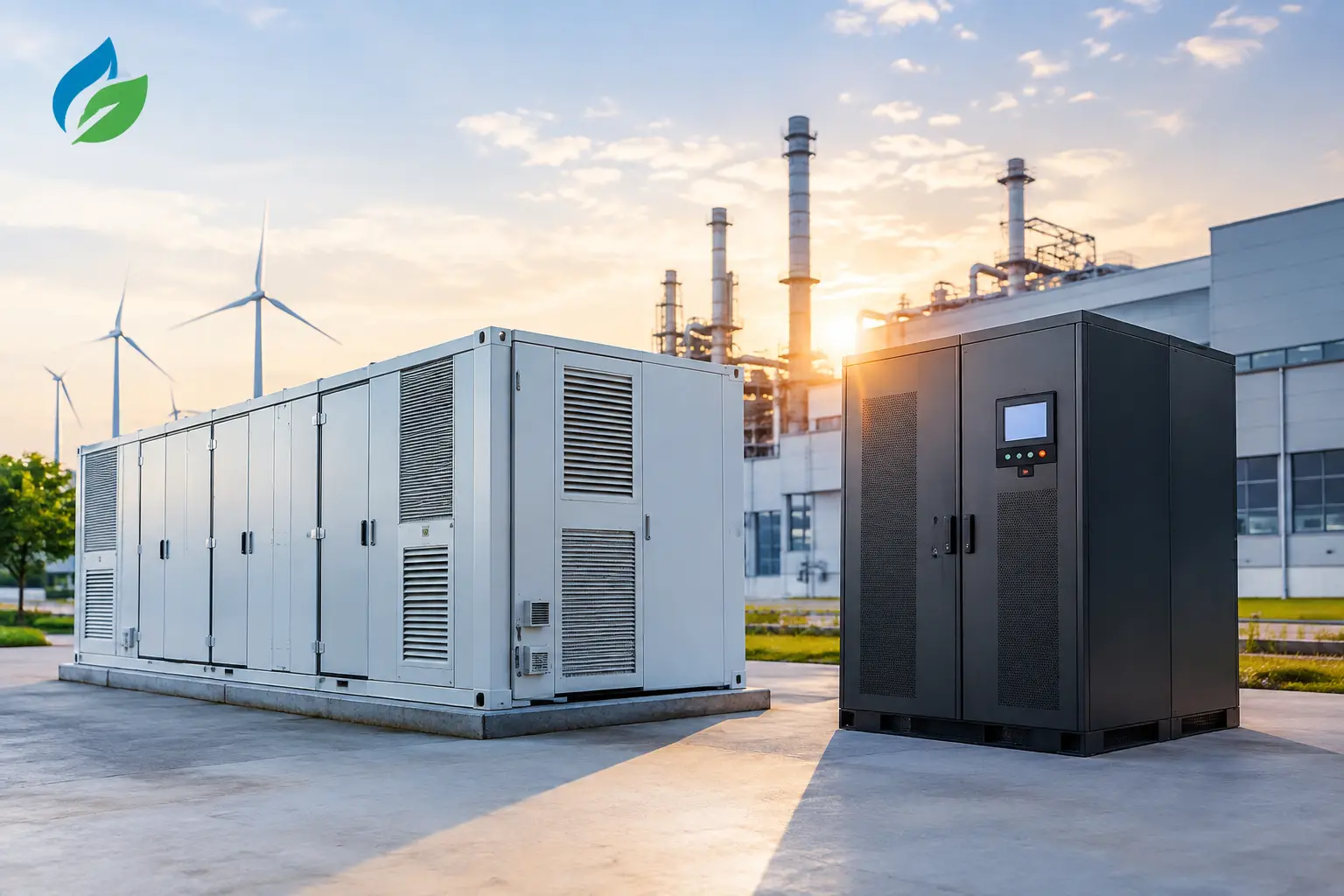
A production line stops for only a few seconds, yet the cost can extend far beyond lost output. PLCs may require resetting, product batches can be compromised and critical process equipment may need a controlled restart. In the BESS vs UPS decision, the right answer is not simply about choosing the largest battery. It is about matching the response speed, power quality and control strategy to each critical load.
For industrial and commercial energy users, UPS and battery energy storage systems serve different purposes. A UPS protects sensitive loads at the instant power quality fails. A BESS can sustain selected operations for longer while also reducing maximum demand, storing solar energy and responding intelligently to tariff and site conditions. Treating them as interchangeable can create an expensive resilience gap.
BESS vs UPS: the essential difference
An uninterruptible power supply, or UPS, is designed to keep connected equipment powered without interruption when the utility supply dips, fluctuates or fails. In an online UPS configuration, the load is continuously supplied through the UPS inverter. This provides highly stable power and near-instantaneous protection for systems that cannot tolerate a transfer delay.
A battery energy storage system is a larger, grid-connected energy asset. It typically combines battery racks, a battery management system, power conversion equipment, protection systems and an energy management system. Its primary role may be backup power, but it can also charge during lower-cost periods, absorb surplus solar generation, limit peak demand and dispatch energy according to an operational plan.
The distinction matters because a standard BESS does not automatically provide the same zero-break transfer performance as a UPS. Its response depends on the inverter, protection design, transfer arrangement and whether the installation is configured for grid-forming or islanded operation. A BESS designed only for demand management may not protect a server, control panel or automated production line from a millisecond-scale disturbance.
When a UPS is the right investment
A UPS is the correct first line of defence for low-to-medium power loads where continuity and power conditioning are non-negotiable. This commonly includes data rooms, network infrastructure, SCADA systems, security equipment, fire and life-safety controls, laboratory instruments, precision electronics and critical PLCs.
Its value is not measured by battery capacity alone. A properly specified UPS filters voltage variation, manages short-duration disturbances and gives downstream equipment time to ride through an outage or transfer safely to a standby generator. For a critical control system, that power quality protection is often more valuable than hours of stored energy.
UPS systems do have limitations. Runtime is usually measured in minutes rather than hours unless substantial battery banks are installed. Scaling a UPS for large motor loads or whole-facility backup can become capital-intensive. It also does not normally create a direct financial return through peak shaving, solar optimisation or energy-market participation.
For these reasons, a UPS should be sized around the loads that genuinely require uninterrupted, conditioned supply. Oversizing it to cover every non-critical load can divert capital away from a broader site energy strategy.
Where BESS delivers greater operational value
A BESS becomes compelling when a site needs more than momentary protection. High maximum-demand charges, variable solar output, restricted grid capacity and exposure to longer outages all strengthen the commercial case for storage.
During normal operation, intelligent BESS dispatch can reduce the site’s peak import from the grid. Rather than allowing a short production surge to establish the month’s demand charge, the battery can discharge at the critical interval. This is peak shaving with a direct operational objective: lower utility costs without constraining productive load.
When paired with solar PV, BESS also increases the value of generation produced on site. Energy that would otherwise be exported at limited value, or curtailed because demand is low, can be stored for later use. The battery can then support late-afternoon demand, evening operations or planned high-load periods when solar generation falls.
For resilience, a correctly engineered BESS can keep selected essential loads running through a prolonged outage. The achievable runtime depends on usable battery capacity, load profile, motor starting requirements, ambient conditions and the chosen backup scope. Protecting an entire factory for eight hours is very different from supporting control systems, refrigeration, emergency lighting and a priority production line.
The strongest BESS business cases therefore combine resilience with daily value creation. Backup capacity that sits idle until an outage offers protection. Backup capacity that also reduces demand charges and improves solar self-consumption can produce real savings, not theoretical ones.
Response time is only one design question
It is easy to focus on whether a BESS or UPS reacts faster. In practice, energy decision-makers should evaluate four connected questions: which loads must never lose supply, which loads can tolerate a brief transfer, how long essential operations must continue, and what the energy asset should deliver on ordinary working days.
A UPS typically answers the first question. A BESS addresses the second, third and fourth, provided the system architecture supports the required backup mode. Some sites require a generator as well. In that arrangement, the UPS bridges immediate disturbances, the BESS supports fast power delivery and demand control, and the generator provides extended-duration supply during a grid outage.
This layered approach avoids expecting one technology to perform every function. It also enables more precise investment. A critical control room may need an online UPS, while a BESS supports the main switchboard or selected essential distribution boards. Less critical loads can be shed automatically to extend battery runtime.
How AI control changes the BESS equation
Without intelligent control, a BESS can become a costly battery that discharges at the wrong time. Charging when tariffs are high, holding capacity while a site peak occurs, or exporting energy when it would create more value on site reduces the financial case.
Enterprise-grade AI and energy-management software improve this decision-making. By analysing interval demand, solar forecasts, battery state of charge, operating schedules and demand thresholds, the controller can determine when to charge, hold or discharge. It can also prioritise solar energy, manage load shedding during an outage and preserve sufficient reserve for defined resilience requirements.
For facilities teams, visibility is equally important. Management reporting should show battery availability, energy flows, demand reduction, solar contribution, avoided costs and operational events in a format that engineering, finance and sustainability teams can use. This supports transparent energy-performance reporting and helps organisations evidence progress against Scope 1 and Scope 2 goals.
Amsolar AI brings this operational layer together through integrated BESS capability, AI controllers and Management Reporting System software. The objective is practical: connect physical energy assets to smarter control, so storage supports uptime, cost control and measurable sustainability performance from one operating environment.
Choosing the right architecture for your site
The best choice is often not BESS or UPS, but BESS and UPS, each assigned to the work it performs best. Start with a load-criticality assessment rather than a battery specification. Map equipment by outage tolerance, restart consequence, power-quality sensitivity and required runtime.
Then model the site’s 15-minute or half-hourly load profile, depending on the billing regime, alongside solar production and maximum-demand exposure. This reveals whether a BESS can generate ongoing value through peak shaving and solar shifting, and how much capacity must remain reserved for backup.
Engineering details should not be treated as an afterthought. Confirm protection coordination, fault levels, inverter capability, changeover arrangements, harmonic performance, fire safety requirements, battery degradation assumptions and maintenance responsibilities. For medium-voltage users, integration at the right point in the electrical network is central to both safety and savings.
The useful next step is to define an outage scenario that reflects reality: which loads must operate, for how long, and which loads can be shed in sequence. That single exercise usually makes the BESS vs UPS decision clearer, while creating a stronger foundation for a future-ready energy system.