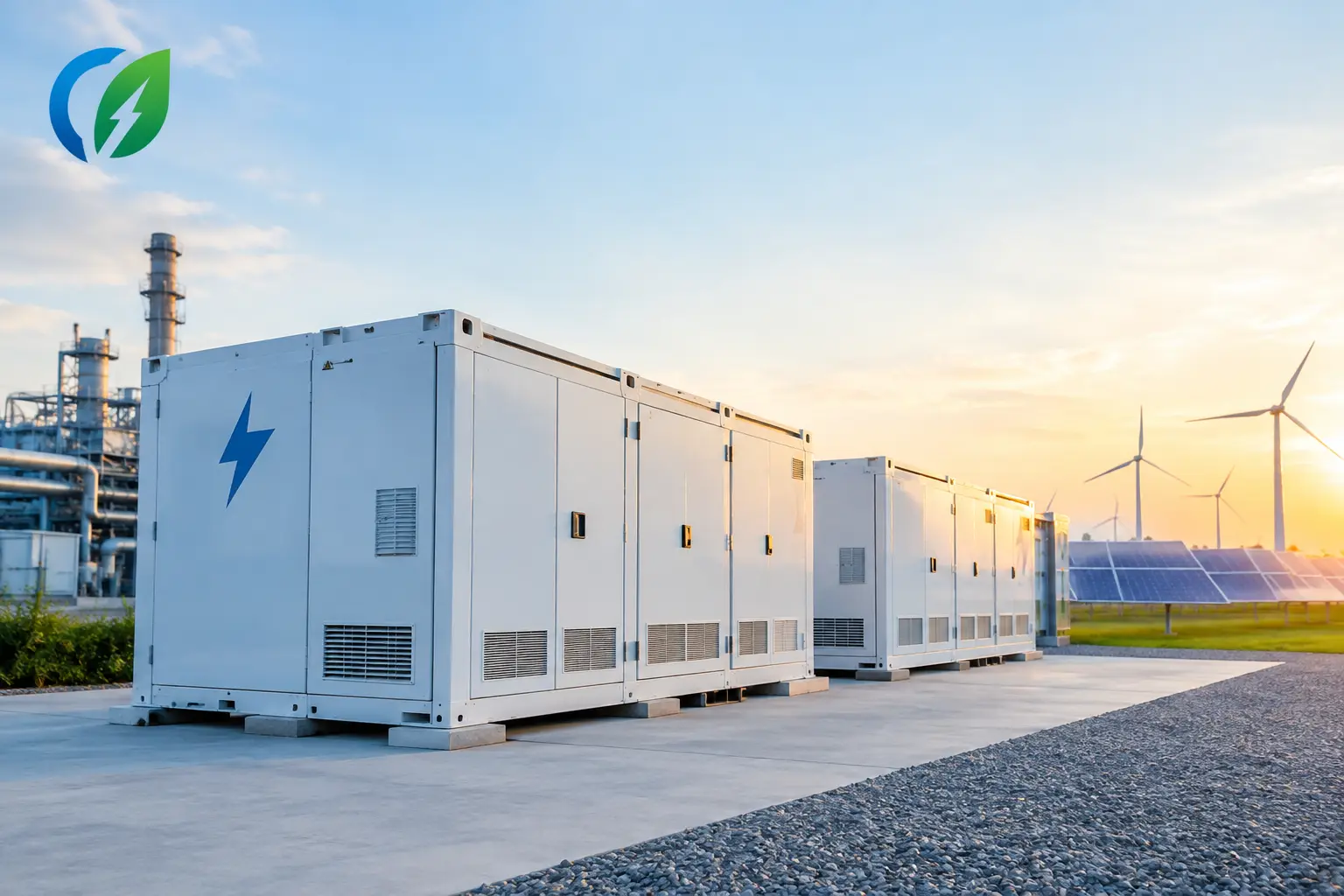
A production line does not stop because a site has run out of physical floor space. It stops when available electrical capacity cannot support the next machine, process expansion or simultaneous load. Power enlargement using BESS offers a practical alternative to waiting for a major grid or transformer upgrade: use battery energy storage to supply controlled power at critical moments, so the site can operate beyond its existing import constraint.
For industrial and commercial operators, this is not simply a battery project. It is a capacity, uptime and cost-control decision. The value depends on accurate load data, a correctly sized system and intelligent dispatch that protects the loads that matter most.
What power enlargement using BESS means
Power enlargement using a BESS is often described as a non-wires capacity upgrade. Rather than increasing the site’s grid connection immediately, the battery discharges when demand approaches an agreed import limit. The grid supplies its permitted capacity and the BESS provides the additional short-duration power required by the facility.
Consider a factory with a 2 MW available supply that needs 2.5 MW during defined production events. A battery can contribute the 500 kW gap during those peaks, allowing the expansion to proceed without routinely exceeding the import threshold. The battery then recharges during lower-demand periods, subject to the site’s tariff, operating profile and available network capacity.
This approach can defer capital-intensive electrical works and reduce disruption to operations. It can also provide a faster route to supporting a new production line, larger HVAC plant, charging infrastructure or process equipment. However, it does not create unlimited energy. A battery has a defined power rating in kW and energy capacity in kWh or MWh. Both must match the real operating duty.
Why capacity constraints affect more than expansion plans
A constrained incoming supply creates operational risk long before a site officially exceeds its maximum demand. Facilities teams may stagger machinery, delay equipment commissioning or curtail useful loads to avoid a demand spike. Finance teams face rising capacity charges or penalties. Production teams inherit restrictions that make scheduling less efficient.
The cost is not always visible in a utility bill. It can appear as lost throughput, delayed expansion, avoidable downtime and a larger contingency margin built into operations.
A well-designed BESS turns this static constraint into a controllable operating boundary. It can cap grid import at a defined level while supporting priority loads behind the meter. When paired with solar, the system can also store surplus generation for later use rather than exporting it at a lower value or allowing generation to be curtailed.
The business case: more than peak shaving
Peak shaving is central to the model, but it is only one source of value. The strongest projects stack several practical use cases without compromising battery availability for the site’s primary objective.
During high-demand periods, the BESS can discharge to limit maximum demand and protect the agreed import capacity. During lower-demand periods, it may recharge from lower-cost electricity or onsite solar, where the commercial case supports this. It can also provide controlled backup for selected critical loads, improving resilience during supply disturbance.
The priority order matters. If power enlargement is the main reason for investment, the battery should reserve enough energy for forecast production peaks. A system that discharges early for tariff arbitrage may be unavailable when a large motor starts or when several processes overlap. Real savings, not theoretical, depend on operating rules that reflect the site’s actual risks.
Size the battery around the load profile
A common mistake is to size a battery from the site’s monthly consumption alone. Power enlargement is driven by interval demand, peak duration, production schedules and the shape of load events.
The first question is how much additional power is needed. The second is how long that gap persists. A 500 kW shortfall lasting 15 minutes requires a very different energy capacity from a 500 kW shortfall lasting two hours. Battery power determines the immediate support available; battery energy determines how long it can sustain that support.
Engineering teams should analyse at least the following:
- interval demand data and the timing of maximum-demand events;
- planned production changes, new equipment and seasonal load variations;
- transformer, switchgear and cable ratings within the site;
- solar generation patterns, where onsite PV is present; and
- critical-load priorities during grid disturbances or load-shedding events.
The result should be a dispatch design, not merely a battery nameplate. It should define the import cap, battery reserve level, charge windows, discharge triggers and exception rules for unusual operating conditions.
Power quality and protection still matter
A BESS cannot compensate for every upstream or internal electrical limitation. If a transformer, busbar, cable or protection setting is already at its thermal or fault-duty limit, site electrical works may still be required. Likewise, network agreements and connection conditions must be checked before changing how a facility imports or exports power.
This is why an engineering-led assessment is essential. The objective is not to avoid infrastructure investment at any cost. It is to identify whether a battery can defer it, reduce its scale or create a more commercially sensible phased expansion plan.
Intelligent control makes the capacity usable
Static battery schedules are rarely sufficient for industrial sites. Production can change, solar output can vary and a single unplanned process can alter the demand curve in minutes. Enterprise-grade AI control uses live meter data, forecasts and operating constraints to make battery dispatch more responsive.
A controller can forecast approaching demand peaks and pre-position the battery state of charge before they occur. It can prioritise solar charging where appropriate, maintain a resilience reserve, prevent import from crossing a defined threshold and coordinate load shedding when the site requires an additional layer of protection.
This is where a unified energy-management environment creates greater value. Rather than treating the battery as an isolated asset, operators can view grid import, solar output, battery status, HVAC and major process loads together. Environmental sensor data can add further context for energy-intensive HVAC and air-compressor operations.
Amsolar AI combines this operational visibility with AI-enabled dispatch, management reporting and engineering experience from physical solar and energy assets. The aim is smarter control that facilities, finance and sustainability teams can verify in the same data environment.
Measure performance in operational terms
A successful project should be measured against agreed business outcomes, not only battery cycles. Relevant indicators include avoided maximum demand, hours of additional capacity made available, peak events covered, solar self-consumption, battery availability and the reduction in unplanned operating constraints.
For finance teams, reporting should distinguish between savings caused by demand control, solar optimisation and tariff timing. For operations teams, it should show whether the battery was ready when required and whether import limits were maintained. For sustainability leaders, the same platform can support clearer Scope 1 and Scope 2 reporting by connecting energy use with operational action.
Transparency is particularly important when site conditions change. A new shift pattern, additional machinery or altered solar output can change the battery’s optimum operating strategy. Continuous monitoring allows the control logic to be refined rather than leaving performance tied to assumptions made at commissioning.
A future-ready route to controlled growth
Power enlargement using BESS is most effective when it is treated as part of a wider energy strategy – alongside solar, demand management, electrical infrastructure and production planning. It will not replace every grid upgrade, and it should never be designed around headline battery capacity alone.
For the right high-demand site, however, intelligent storage can turn a capacity constraint from a barrier into a managed operating condition. The practical next step is to establish the real shape of demand, identify the moments when capacity is genuinely scarce and design control around the production that cannot afford to wait.