



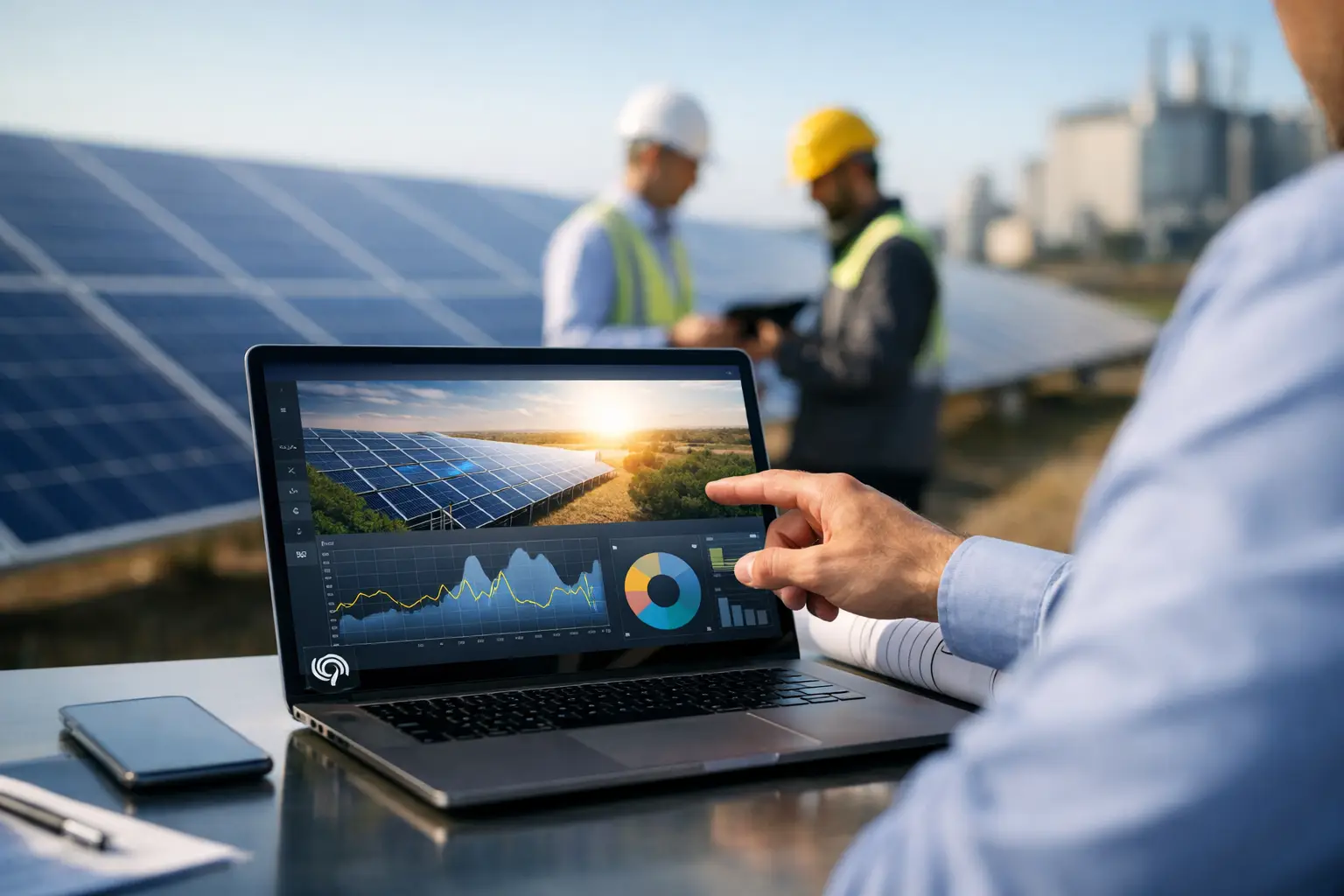
A factory can generate substantial solar power at midday and still incur high electricity charges later that afternoon. The issue is rarely a lack of data. It is the lack of timely, coordinated decisions across solar generation, battery storage, production loads and grid demand. Solar energy management software turns those separate signals into practical operating actions, helping industrial and commercial sites buy, use, store and report energy with greater control.
For high maximum-demand users, this is not a dashboard exercise. It is an operational and financial requirement. Electricity costs are shaped by more than total kilowatt-hours consumed. Demand peaks, tariff periods, power quality, equipment schedules and the availability of onsite generation all affect the final bill. A platform built for industrial use must make these variables visible, then act on them without compromising uptime.
What Solar Energy Management Software Should Do
At its core, solar energy management software is the intelligence layer between physical energy assets and business outcomes. It gathers live data from inverters, meters, battery energy storage systems, grid connections and selected loads. It then presents a clear operating picture while using forecasting and automation to improve the next decision.
For an industrial site, that means answering questions that matter to operations and finance: Is solar generation being consumed onsite or exported at a lower value? Is a battery held for the coming demand peak or discharged now? Which production area is driving the maximum demand? Is a sudden load increase normal, or does it require intervention?
Monitoring alone cannot answer these questions fast enough. Enterprise-grade AI combines live site conditions with expected solar output, historic load behaviour, tariff structures and battery constraints. The result is smarter control based on the site’s actual priorities, rather than a fixed rule that may no longer suit the day’s operating conditions.
Visibility must lead to action
Many organisations already have inverter portals, utility bills and spreadsheets. These tools can show what happened, often after the relevant billing period has passed. They do not necessarily coordinate multiple assets or prevent avoidable cost events.
A useful management platform closes that gap. It should provide real-time consumption and generation visibility, identify emerging peaks, compare site performance against targets and create a reliable record for operational review. More importantly, it should support automated responses such as battery dispatch, solar prioritisation, demand control and non-critical load shedding where appropriate.
Automation should never mean losing engineering oversight. Facilities and energy teams need control boundaries, approval rules and transparent explanations of what the system is doing. The goal is not to hand over the plant to an algorithm. It is to give experienced teams faster, more consistent execution against defined commercial and operational objectives.
How Smarter Control Reduces Electricity Costs
The financial case depends on the site’s load profile, tariff and installed assets. However, three areas consistently create value for medium-voltage industrial and commercial users: increasing solar self-consumption, managing maximum demand and optimising battery operation.
Solar prioritisation ensures available solar power serves suitable onsite loads before electricity is imported from the grid. This may sound straightforward, but variable cloud cover, changing production demand and inverter limits make it a continuous balancing task. A software platform can forecast generation and consumption, allowing the site to prepare for shortfalls or surpluses rather than react after they occur.
Demand control focuses on the cost of sharp grid import peaks. A single period of simultaneous equipment start-up, process change or air-compressor operation can lift maximum demand and materially affect charges. The right system detects a developing peak early and responds according to the site’s pre-set hierarchy. It may discharge a battery, defer a flexible load, adjust HVAC operation or alert the facilities team before the threshold is breached.
Battery control requires even greater discipline. Discharging a BESS at the wrong time can leave no capacity for the more expensive peak that arrives later. Holding too much energy can also mean missing a cost-saving opportunity. Intelligent dispatch considers state of charge, battery health, forecast solar, expected site demand, tariff windows and the reserve level required for resilience. Real savings, not theoretical savings, come from matching each dispatch decision to the site’s operating reality.
The Operational Data That Often Gets Missed
Energy performance is affected by more than solar panels and batteries. HVAC systems, air compressors, process equipment and environmental conditions can influence load patterns significantly. For many sites, these are the controllable sources of waste and demand volatility.
Integrating environmental sensors alongside energy data gives operations teams more context. A rise in HVAC consumption, for example, may be reasonable during higher ambient temperatures. It may also indicate poor scheduling, control drift or maintenance needs. Similarly, air-compressor energy use can reveal leakage, excessive pressure settings or equipment running outside production requirements.
This broader view helps organisations move from reactive fault finding to continuous energy improvement. It also makes conversations between engineering, operations, finance and sustainability teams more productive because they are working from the same live evidence.
Reporting that stands up to scrutiny
Industrial energy decisions need auditable reporting, not attractive charts without context. Management teams require clear views of consumption, solar yield, battery contribution, demand events, avoided costs and exceptions requiring attention.
For sustainability teams, the same platform should simplify Scope 1 and Scope 2 reporting by creating a traceable data foundation. This is increasingly relevant for organisations responding to the Energy Efficiency and Conservation Act 2024 requirements. Good reporting reduces manual data handling, but its greater value is accountability: managers can see whether operational changes produced the expected outcome.
The most effective reporting is tailored by role. A plant manager may need alert-driven operational status. A renewable energy manager may need generation performance, curtailment and self-consumption trends. Finance leaders need measurable cost impact and a credible basis for investment decisions. One data source can serve each audience without creating competing versions of the truth.
Choosing Software for an Industrial Site
Not every platform is designed for high-energy-demand operations. Consumer-style monitoring may be adequate for observing a small rooftop system, but it is unlikely to provide the control depth, integration capability or reliability required by a factory or asset-intensive enterprise.
When assessing solar energy management software, decision-makers should look beyond feature lists. The critical test is whether the provider understands the physical system as well as the digital layer. Software recommendations must account for switchgear, metering architecture, inverter behaviour, load criticality, BESS limits and site safety procedures.
A strong implementation begins with engineering validation of the site’s energy flows and control points. It defines what can be automated, what must remain under manual authority and how the system behaves during communications loss, maintenance or abnormal operating conditions. This is where solar engineering and commissioning experience makes a practical difference. Digital intelligence is only valuable when it can operate safely with real assets.
Scalability also matters. A site may begin with solar monitoring and demand alerts, then add battery storage, controllable loads or additional facilities. The platform should support that journey without forcing teams to replace the data layer every time the energy strategy advances.
Amsolar AI combines this engineering-grounded approach with AI controllers, Management Reporting System capabilities and BESS intelligence built for industrial and commercial users. The focus is direct: connect physical energy assets to decisions that reduce cost, improve visibility and protect operational reliability.
A Better Starting Point Than Another Dashboard
The right first step is not selecting software based on the number of screens it offers. Start by identifying the cost events and operational constraints that matter most. That may be a recurring maximum-demand penalty, poor solar self-consumption, uncertain battery value, difficult ESG reporting or limited visibility across several energy-intensive systems.
From there, define measurable targets and the authority required to achieve them. A well-designed platform gives the site a disciplined way to observe, forecast, decide and act. As energy costs, compliance expectations and operating pressures continue to evolve, that control environment becomes a practical foundation for a cleaner, future-ready facility.




6 Comments
[…] can form faster than a person can identify it, particularly when multiple loads start at once or solar generation drops suddenly under cloud cover. Shift changes, competing priorities and incomplete data create further […]
[…] sites may see additional value because surplus daytime generation can charge the battery for use later. This improves solar self-consumption while reducing evening […]
[…] integrated controls, solar availability can inform HVAC scheduling and setpoint strategies. Where building conditions allow, cooling can be […]
[…] Cloud cover, shift patterns, process loads and export rules all influence value. By forecasting solar generation and site demand together, an EMS can prioritise on-site solar consumption, schedule suitable loads […]
[…] pressure settings or run-hours that no longer match production needs. Solar data can show whether on-site generation is being consumed, curtailed or offset by avoidable simultaneous loads. Battery data can confirm […]
[…] is not to create a second manual process for sustainability. Metered grid consumption, onsite solar generation and energy-saving actions should feed a transparent reporting structure from the same controlled […]