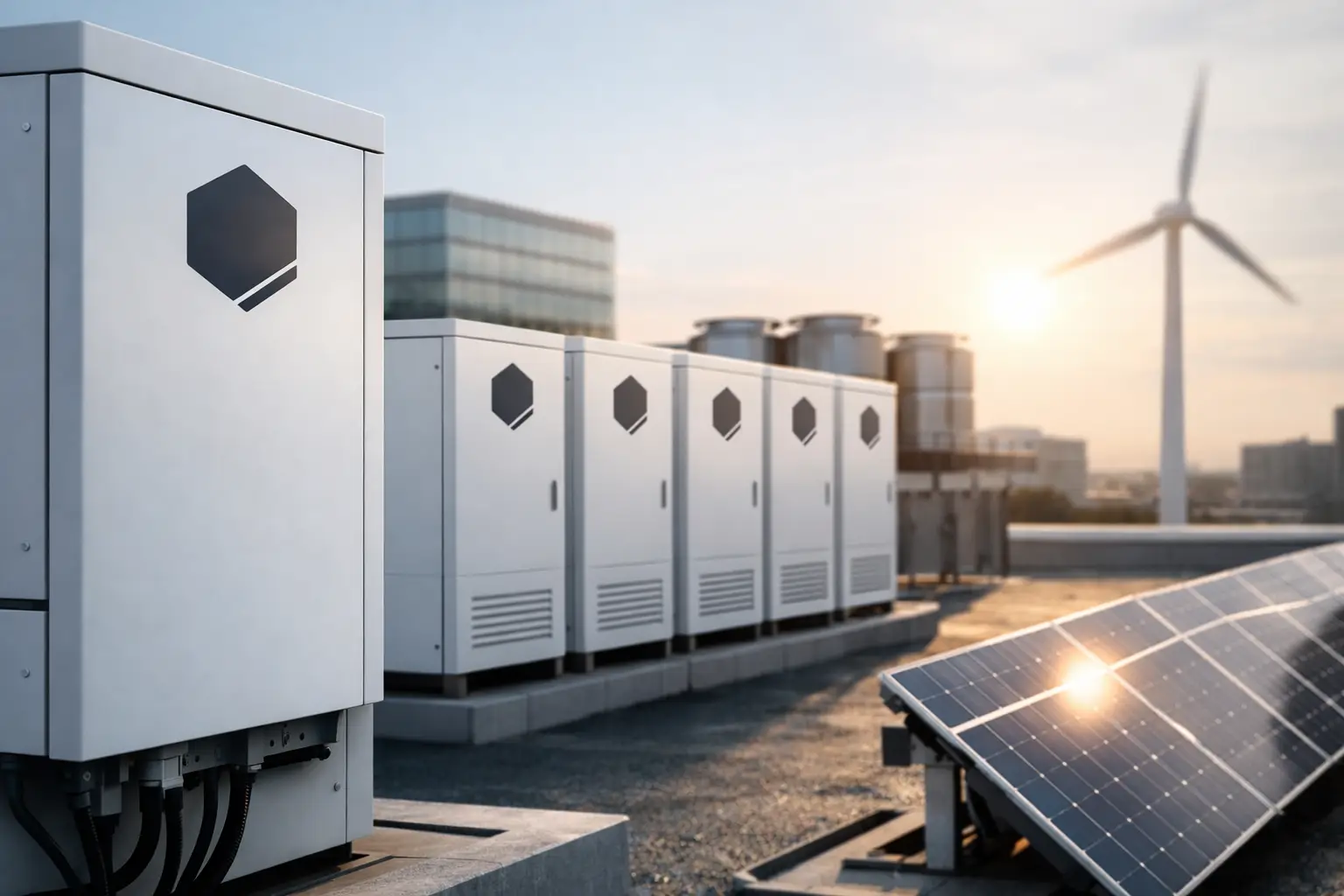
A commercial battery storage system is no longer simply a back-up asset parked beside a switchroom. For industrial and commercial sites facing high maximum-demand charges, variable solar output and tight production schedules, it can become an active financial control. The value comes from when and how the battery is dispatched, not just from its installed capacity.
A poorly controlled battery may reduce a few peaks while missing the events that shape the monthly bill. A properly engineered and intelligently managed system can charge from surplus solar, protect against demand spikes, support critical loads and give energy teams a clear record of what delivered the saving. That is the difference between theoretical potential and an operational energy strategy.
What a commercial battery storage system should achieve
The business case begins with the site load profile. A factory with brief, severe peaks from compressors, chillers or process equipment needs a different battery strategy from a warehouse with a broad evening demand period. Likewise, a site with significant rooftop solar may prioritise self-consumption, while another may place more value on peak shaving and resilience.
A commercial battery storage system should therefore be sized and controlled against real operating data. Its purpose is generally to reduce imported energy at the most expensive times, lower maximum demand, capture solar generation that would otherwise be exported or curtailed, and maintain continuity for selected loads.
These outcomes do not always align perfectly. Holding energy in reserve for resilience can reduce the energy available for daily peak shaving. Charging aggressively for a forecast demand event may leave less room to absorb midday solar. The right operating policy reflects the site’s production priorities, tariff structure, grid constraints and tolerance for interruption.
Peak shaving is a control challenge, not just a capacity question
Maximum demand can be shaped by a short interval, yet its financial impact may continue through the billing period. That makes timing critical. Batteries must respond before or as site demand crosses the agreed threshold, with enough state of charge available to sustain discharge for the relevant period.
Static schedules have a role where operations are predictable, but they are often insufficient for active industrial facilities. Shift changes, ambient temperature, production batches and equipment start-up patterns can move the demand peak without warning. Real-time monitoring, load forecasting and automated dispatch give the battery a better chance of acting at the point of commercial value.
An enterprise-grade controller can combine historical patterns with live meter data, solar forecasts and battery conditions. Instead of discharging at a fixed hour every day, it can preserve capacity for a likely peak, then adjust as actual load develops. The result is smarter control of demand exposure, with decisions that can be reviewed rather than treated as a black box.
Solar and storage perform better as one operating system
Solar production rarely follows the site’s consumption profile exactly. Midday generation can exceed demand, while the most costly demand period may occur later, after output has declined. Battery storage bridges part of that gap by retaining usable solar energy for a more valuable time.
However, solar prioritisation requires discipline. Charging a battery from the grid when solar will soon be available can weaken the economics. Exporting solar while importing electricity later may also be avoidable, depending on tariff arrangements, battery availability and operational requirements. Intelligent controls should continually assess these trade-offs rather than follow a single rule.
For sites with multiple assets, a unified platform is particularly useful. It gives facilities and energy managers visibility of inverter generation, battery state of charge, grid import, load behaviour and demand events in one environment. This reduces the time spent reconciling separate dashboards and helps identify whether a poor result came from weather, production demand, an equipment issue or a control setting.
Design decisions that determine commercial value
Battery power and battery energy are different decisions. Power, measured in kilowatts, determines how strongly the system can reduce a demand spike. Energy, measured in kilowatt-hours, determines how long it can maintain that support. A short, sharp peak may justify higher power with modest duration; a sustained demand plateau may require more stored energy.
The point of interconnection matters as well. Electrical studies must assess transformer capacity, protection coordination, fault levels, power quality and the operating limits of existing solar assets. For medium-voltage users, integration should never be treated as a standard container installation. It is an engineered change to a live energy system.
Battery degradation also belongs in the financial model. Higher cycling can create more daily savings but may affect long-term usable capacity. Temperature, depth of discharge, charge rate and control logic all influence asset life. A credible proposal makes these assumptions visible, including the expected operating window, warranty conditions, maintenance needs and performance monitoring method.
Visibility turns savings into a management decision
Finance teams need more than a headline saving estimate. They need traceable evidence: baseline demand, avoided peak intervals, battery dispatch history, solar contribution, grid imports and exceptions. Operations teams need alerts that identify unusual behaviour before it becomes downtime or lost savings.
This is where management reporting matters. Monthly reports should translate technical activity into commercial outcomes while retaining enough operational detail for engineering review. Energy managers can then compare performance by site, verify whether controls are meeting their target and adjust policies as tariffs or production patterns change.
The same data also strengthens sustainability reporting. A battery does not automatically reduce emissions in every operating mode, particularly if it is charged from the grid at the wrong time. Measuring solar charging, grid imports and site consumption enables more defensible Scope 1 and Scope 2 reporting, while supporting the data discipline expected under the Energy Efficiency and Conservation Act 2024.
Reliability requires operating rules, not assumptions
A battery can support resilience, but it is not a substitute for defining critical loads and continuity procedures. If outage support is required, the system must be designed with the appropriate islanding capability, protection arrangements and reserve state of charge. Not every battery installation is intended to operate during a grid outage.
Facilities teams should agree the hierarchy before commissioning. Which loads must remain available? How long should the system support them? When should commercial optimisation give way to reserve protection? Clear rules prevent a controller from pursuing a marginal demand saving at the expense of a more important operational requirement.
Cybersecurity, access control and alarm handling deserve equal attention. Connected energy assets need defined user permissions, secure communications and a practical escalation process. Remote visibility is valuable only when the right people can trust the data and act on it quickly.
From asset installation to continuous optimisation
The strongest commercial battery projects are managed as ongoing performance programmes. Load profiles change, equipment is added, production shifts evolve and tariff structures can be revised. The control strategy that produced savings in the first quarter may not be the best strategy a year later.
Amsolar AI combines solar engineering experience with AI controllers, battery energy storage and Management Reporting System capabilities to connect these decisions in one operational environment. The aim is not simply to install more equipment. It is to make every available energy asset work harder against measurable cost, uptime and sustainability targets.
Before committing to a commercial battery storage system, start with interval data, demand history, solar performance and the site’s non-negotiable operating constraints. A battery delivers its best value when its engineering, controls and reporting are designed around the way your business actually consumes energy.